
What Hancock County Deed Records Show
A recorded deed names the parties and states the form of conveyance. It also carries the land description. It lists the execution and recording dates and the reference the Recorder assigned. The form matters. Different instruments convey different interests or grow out of different proceedings. The label on an instrument shapes what it actually did.
| Deed Type | What It Does | Common Use |
|---|---|---|
| Warranty deed | Conveys the stated estate with deed covenants | Ordinary sale transfer |
| Quitclaim deed | Conveys the grantor's interest without warranty | Family or title-cleanup transfer |
| Personal representative deed | Conveys through an authorized estate representative | Estate administration |
| Sheriff's deed | Follows a completed court-ordered sale process | Foreclosure sale transfer |
| Tax deed | May follow the statutory delinquent-tax process | Tax-sale chain |
A mortgage or mechanic's lien is not a deed. Each records an encumbrance or a claim instead of ownership. A release, by contrast, can show that an earlier recorded claim was later discharged. Read them as related instruments in the chain. Calling each one a transfer of title would misstate the record.
Search Hancock County Deeds in Doxpop
The county's online Recorder index runs through Doxpop. Its basic search offers Party Name, Super Search, Search Region, and Search. The advanced route adds Legal Description and Document Information. It can cover one county or a wider region. An account is required for full use. Plan and image prices can change, so confirm costs before relying on the service.
| Index field | Best entry | Check in results |
|---|---|---|
| Party Name | Grantor, grantee, lender, or entity | Role, spelling, and date |
| Super Search | A name with uncertain form | Unrelated expanded matches |
| Search Region | Hancock County | Correct county and office |
| Legal Description | Subdivision, lot, or section wording | Same land through each link |
| Document Information | Known type, date, or reference | Exact recorded instrument |
The Doxpop Recorder search appears in the captured source below.
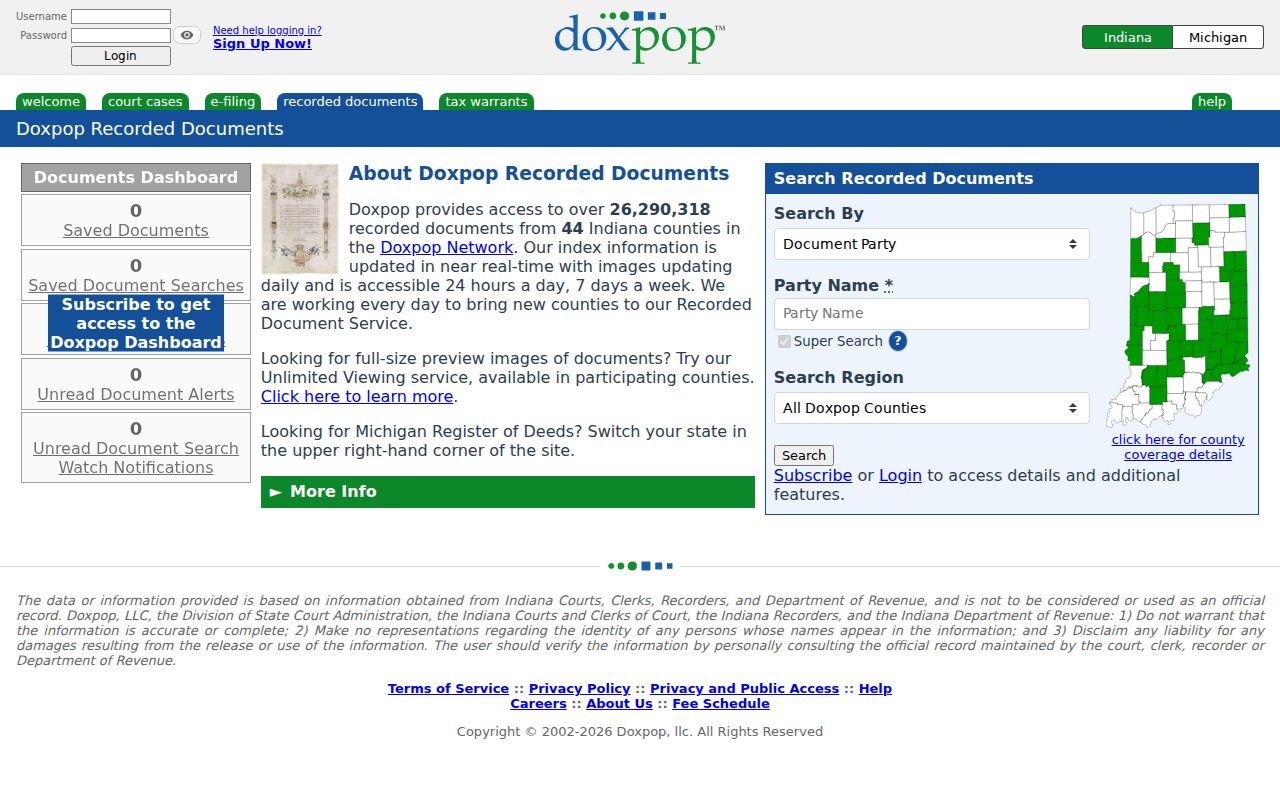
The screen shows the limits of a first pass. A name and county filter only narrow the field. Legal text and instrument details still decide whether a result belongs in the same chain.
Cross the 1968 Hancock County Online Boundary
Doxpop's Hancock index and scanned images begin in January 1968. When your chain reaches that line, note the last online deed. Record its grantor, the legal description, and any older book or page reference it shows. That record becomes a precise starting point for offline work.
Older material survives elsewhere. The Indiana State Library's Hancock County microfilm list covers land and deed material. It reaches back to 1827. The Recorder's older indexes and deed books can extend the chain. So can State Library microfilm, historic plat books, probate material, and the Hancock Public Library local-history room.
Coverage handoff. January 1968 is the start of the online index, not the start of Hancock County deed records.
Use Legal Descriptions to Keep Hancock Deeds Together
Names change. Street numbers change. Tracts split or combine. The legal description is the safer thread through Hancock deed records. Compare subdivision and lot language, section-township-range calls, acreage, adjoining roads, source-deed references, and any plat citation from one instrument to the next.
A 2026 Greenfield secondary plat shows how deep those references run. The current record points back to Wingfield's Reserve, Pierson's Addition, Plat Book A page 8, and a vacated-alley instrument. Search each clue as a recorded reference. None of it is just background color.
Connect Hancock County Plats and Surveys
A deed may cite a subdivision plat, survey, easement, or right-of-way instrument. The Recorder records plats and surveys under county requirements. Those requirements cover content, approvals, sheet size, timing, cabinet storage, and scanning. Pull the cited plat whenever lot lines or easements matter. The county's plat and survey requirements are shown in the project image.
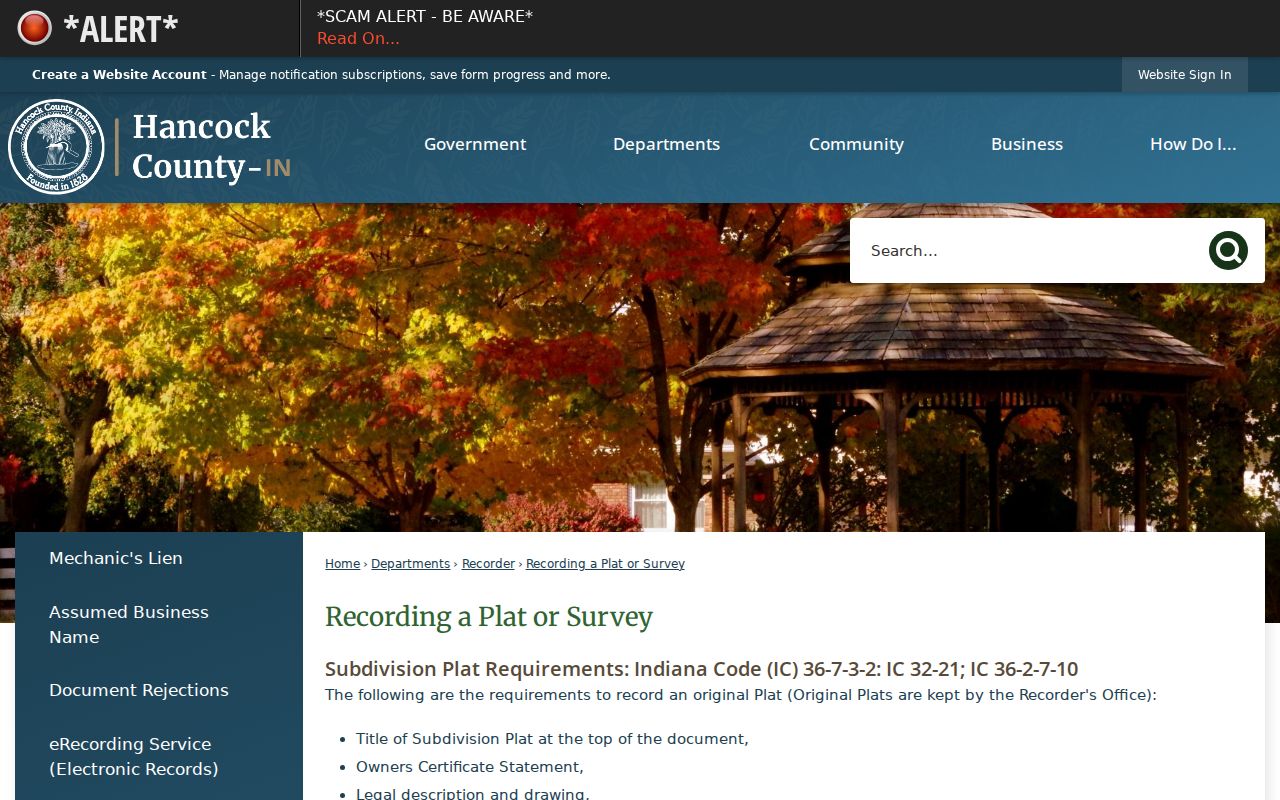
Those requirements explain the recorded plat's role in the land-record chain. Hancock GIS, meanwhile, warns that its parcel lines and corners are low-accuracy approximations. For legal-boundary questions, rely on the deed, the plat, and a licensed survey.
Follow Liens and Releases Beside Hancock Deeds
The same Recorder chain holds more than deeds. Mortgages, assignments, mechanic's liens, releases, easements, covenants, and restrictions all appear there. Match each item by parties, legal description, dates, and cross-references. A release should connect to the instrument it discharges. A mortgage is not a conveyance of current ownership.
Keep court and land records separate on a distressed parcel. A Sheriff's Sale list entry can lead to a MyCase case and judgment. The later deed belongs in the Recorder chain. Tax status stays with the Treasurer. Preserve canceled or postponed status exactly as displayed.
Set Up Hancock County Property Watch Carefully
Hancock County links a free Doxpop Property Watch service that can alert on indexed activity. The county warns that it is not fraud prevention. Doxpop notes the risk of false matches for rural properties in the same section. Treat any alert as a prompt to inspect the instrument itself. The county Property Alert notice appears here.
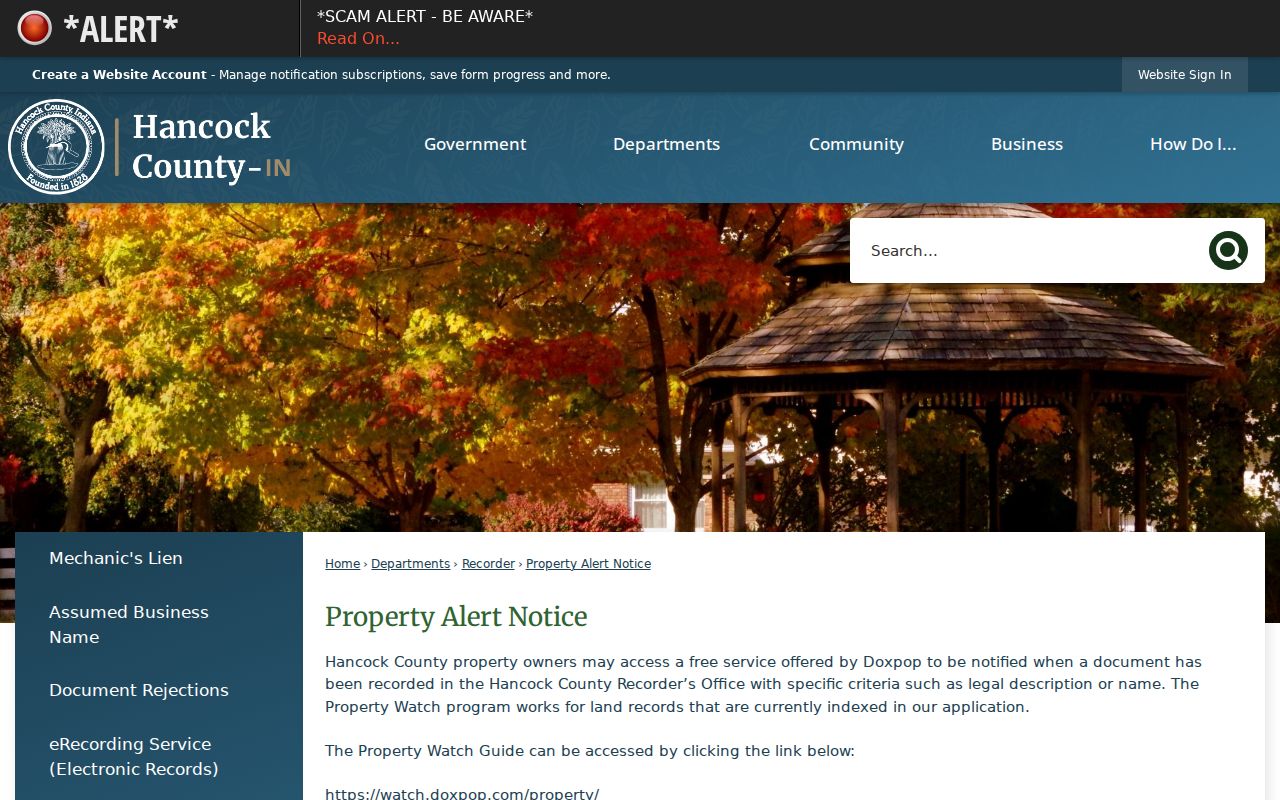
Before deciding an alert concerns the monitored property, compare its section, subdivision, lot, and legal wording. Check the parties, the image, and the Beacon key too. Only then treat it as a match.
Walk the Hancock County Grantor-Grantee Index
Doxpop indexes recorded Hancock instruments by party. Start from a current parcel-card name. Then confirm the matching land through the legal description and the newest deed. Party names alone can join unrelated people or entities, so the land description has to carry the weight.
- Find the current owner's acquisition instrument with that owner listed as grantee.
- Read the grantor, legal description, instrument reference, and recording date.
- Search that grantor as an earlier grantee and confirm the same land description.
- Repeat until the online coverage boundary, then continue in older indexes and volumes.
- Grantor
- The party conveying the stated interest.
- Grantee
- The party receiving the stated interest.
- Chain of title
- The linked sequence of conveyances for the same land.
- Book and page or instrument number
- The reference used to retrieve a recorded document.
Order a Hancock County Deed Copy
Doxpop supplies indexed access and available images. For an official copy, contact the Hancock County Recorder at 111 American Legion Place, Suite 202, Greenfield. You can also call 317-477-1142. The county also accepts copy requests through the channel described on its public-records gateway. Verify current copy charges and mail-return requirements before sending a request.
Recorded, not guaranteed. Hancock County deed records show instruments accepted for recording. They do not resolve every unrecorded interest, defect, priority issue, or boundary dispute.
A copy request works best when it is specific. Name the grantor and grantee, the document type, and the approximate recording date. Add the instrument number, or the book and page, plus the legal description. The parcel key helps the Recorder locate the file, but the legal text still governs. Say whether a plain image or a certified copy is needed.
An index result may show no image. Ask the Recorder in that case, rather than trusting a summary line. Some chains pull in extra instruments. An estate generates its own document. So does a foreclosure, a tax sale, a plat, or an alley vacation. Request those separately and keep the cross-reference with your file. Court orders stay court records. They remain there until a deed or release carrying them enters the land-record chain.
Need to trace an address back to a parcel first? See the Hancock County property search guide. This page stays with recorded conveyances, connected instruments, and the grantor-grantee chain.